

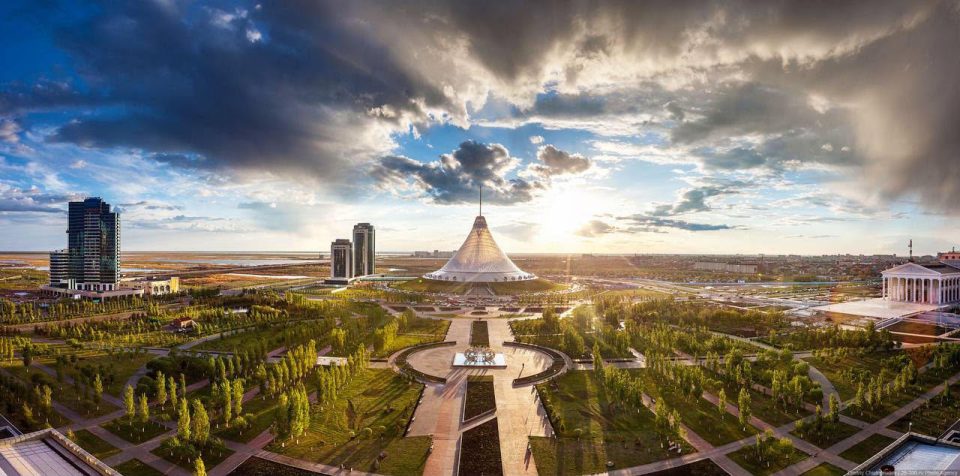
By directing part of the National Fund’s resources to infrastructure development, Kazakhstan is turning accumulated national wealth into long-term public assets.
To invest or to save?
For states with certain financial reserves, one of the main questions of economic policy is how to use accumulated funds with maximum benefit for current and future generations. Kazakhstan has made a choice in favor of investing in the country’s development, directing part of its national savings to the construction of infrastructure and the creation of long-term public assets.
President Kassym-Jomart Tokayev has announced a three-year nationwide construction programme “People’s Construction”. About $14 billion will be directed to it from the National Fund, which accumulates the country’s oil revenues. Kazakhstan, in his words, “must turn into one big construction site.” The funds are intended not for image-building projects but for building everyday infrastructure — schools, hospitals, outpatient clinics, sports facilities, bridges, and roads in all regions.
Over seven years, Kazakhstan’s population has grown by more than 2 million people. Cities are expanding, new residential districts are being settled by young families, and demand for educational and medical facilities is outpacing existing capacity.
Under these conditions, delaying investment only increases the future costs of solving accumulated problems. By directing part of its national reserves toward infrastructure development, Kazakhstan is creating the foundation for long-term growth, leaving future generations, alongside financial savings, modern schools, kindergartens, stadiums, medical facilities, and a country with a decent level of comfort for living.
A proven model
Kazakhstan is not the first country to view social infrastructure as an investment rather than an expense. One of the most studied precedents is Indonesia. During the oil boom of the 1970s, the government directed windfall revenues to the Sekolah Dasar INPRES program, under which more than 61,000 primary schools were built in six years. A study by Nobel laureate in economics Esther Duflo later showed that each additional school per 1,000 children raised the level of education and increased adult earnings by 1.5–2.7%. The oil revenues of that time have long been spent, while the returns on the schools built persist to this day.[1]
Even Norway, which is commonly regarded as the benchmark of saving, does not leave its fund untouched: under its fiscal rule, the government annually directs to the financing of public services an amount corresponding to the fund’s expected real return (currently 3%).[2]
Kazakhstan’s own experience has also already attracted international attention. Economist Terence Ho, writing in Singapore’s The Straits Times, examined Kazakhstan’s children’s savings accounts as an example of investing oil revenues in human capital and a way to reduce the economy’s dependence on oil and gas. “People’s Construction” pursues the same goal but uses a different instrument — it directs part of the funds from oil revenues toward infrastructure. The question is not whether to spend or not, but how far-sighted it is, and Kazakhstan’s choice in favor of long-term social assets places it alongside these countries.[3]
Building on results achieved
An unsophisticated reader might get the impression that Kazakhstan has only just started building schools, hospitals, and roads. But this is far from the case. For example, over the past seven years, the state has already directed about $198 billion to the development of the social sector alone, including $75 billion to education and $35 billion to healthcare.
These funds have been used to open thousands of schools, kindergartens, and hospitals, not only in cities but also in rural areas, which has made it possible to narrow the long-standing gap between rural and urban residents in the conditions for receiving medical care and education.
Implementation of the “People’s Construction” program has already begun. In the first stage, projects worth more than $3 billion have been approved. Plans call for building dozens of healthcare, education, culture, sports, and tourism facilities, with a total area that will ultimately run into hundreds of thousands of square meters. New utility networks and roads will also be laid.
Investing in human capital
The return on public investment is measured not only by the number of facilities and square meters built. Access to quality education and medical care and improved living conditions directly affect the development of human capital and create the preconditions for higher labor productivity and growth in the incomes of the population. Investments in infrastructure can generate economic returns for decades. International data confirm the validity of this approach.
In the UNDP’s 2025 report, Kazakhstan ranks 60th out of 193 countries and territories on the Human Development Index, with a value of 0.837, the highest in Central Asia. UNDP Resident Representative Katarzyna Wawiernia notes the country’s “measurable progress” in living standards, human development, and digital transformation.[4]
UNICEF’s report “Generation 2050” notes that more than half of Central Asia’s population is under 30, and that additional investment in children’s health, education, and development could increase the region’s GDP per capita by 6–14% by 2050 relative to the baseline forecast.[5]
The development of healthcare and improvements in the accessibility and quality of medical care have contributed to lower mortality and higher life expectancy in Kazakhstan. In 2025, it reached almost 76 years, the highest figure since independence. According to UN estimates for 2025, Kazakhstan ranks first in Central Asia in life expectancy, ahead of Uzbekistan (72.7 years), Tajikistan (72.1 years), Kyrgyzstan (72 years), and Turkmenistan (70.3 years).
A financial safety margin
It is worth noting that Kazakhstan is making these investments from a position of economic strength. World Bank data show that GDP per capita in 2025 amounted to $14,700, significantly exceeding the figures of neighboring countries. According to the IMF’s October forecast (World Economic Outlook, 2026), GDP will reach $398 billion this year, and GDP per capita will exceed $19,000. Such dynamics create a substantial margin for long-term investment in infrastructure.[6] [7]
An example for growing economies
Sovereign funds ultimately exist to serve citizens. Kazakhstan’s bet is that the interests of future generations are met not only by the fund’s growing savings but also by the schools, hospitals, and cities in which they will grow up. As commodity exporters prepare for the energy transition, “People’s Construction” offers a pragmatic model: turning exhaustible resource wealth into long-term public assets.
Sources
1. Esther Duflo. Schooling and Labor Market Consequences of School Construction in Indonesia. American Economic Review, 2001. https://www.aeaweb.org/articles?id=10.1257/aer.91.4.795
2. Ministry of Finance of Norway. The Norwegian Fiscal Policy Framework. https://www.regjeringen.no/en/topics/the-economy/economic-policy/economic-policy/id418083/
3. Terence Ho. Invest in our kids. Put Child Development Accounts to better use. The Straits Times, January 9, 2026. https://www.straitstimes.com/opinion/invest-in-our-kids-put-child-development-accounts-to-better-use/
4. UNDP. Human Development Report 2025: Kazakhstan’s indicators. https://www.undp.org/kazakhstan/press-releases/undp-kazakhstan-maintains-its-position-human-development-index-rankings-action-needed-address-inequality-and-environmental
5. UNICEF. Generation 2050 in Central Asia, 2025. https://www.unicef.org/eca/reports/generation-2050
6. World Bank. GDP per capita (current US$), Kazakhstan, 2025. https://data.worldbank.org/indicator/NY.GDP.PCAP.CD?locations=KZ
7. IMF. World Economic Outlook, October 2026, Kazakhstan. https://www.imf.org/external/datamapper/profile/KAZ/WEO
Share this article: